
Top commercial projects show LED video walls function as strategic brand anchors when scale, sightlines and placement match audience flow. Proper pixel pitch aligns resolution to typical viewing distance, preserving logo and type clarity without overspend. Content sequencing and brief repeatable blocks drive recall and conversions LED panel, while modular hardware, redundant power and service access protect uptime. Measurement ties impressions to footfall and sales for ROI. Continue for practical design, operational and measurement guidance that follows.
The Strategic Impact of Scale and Placement on Audience Engagement
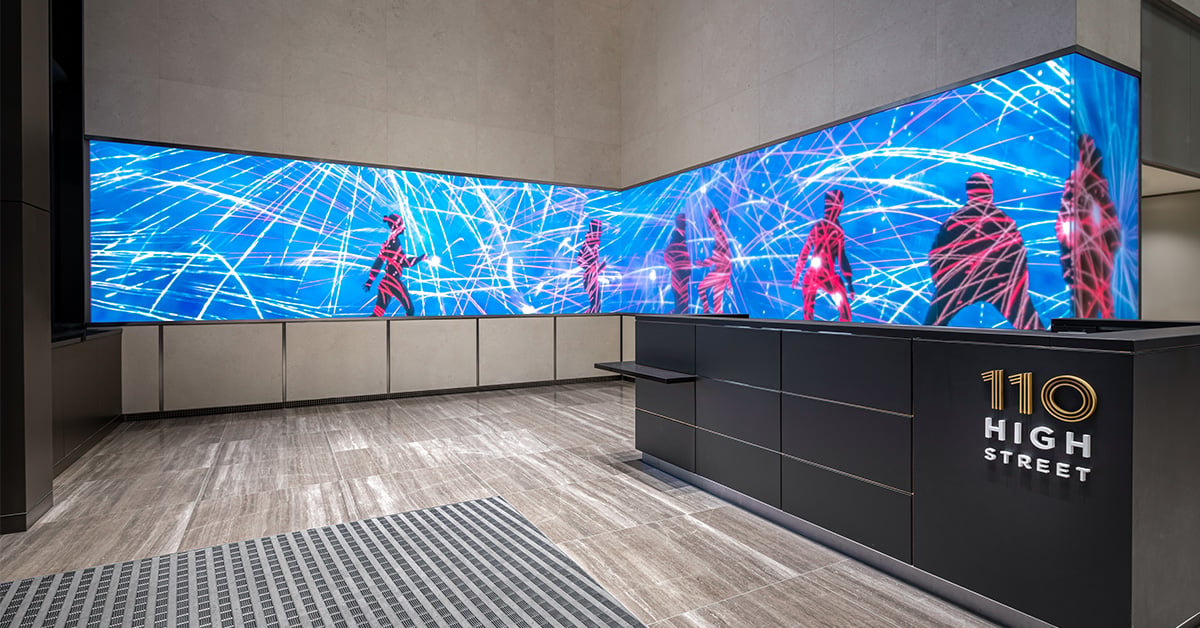
When positioned deliberately, scale and placement transform LED video walls from mere displays into strategic anchors that control sightlines, dwell time, and brand recall. The team evaluates Audience Flow to place screens where movement pauses naturally, using Sightlines Analysis to prevent visual clutter and prioritize unobstructed views. Consideration of Ambient Lighting guarantees content remains vivid without overpowering surrounding spaces, preserving comfort and freedom of movement. Entry Points are treated as tactical windows for first impressions LED display board Malaysia, with proportionate scale signaling brand intent without dominating the environment. The result is a calibrated presence that guides attention, shortens decision paths, and increases recall while respecting spatial autonomy. Outcomes are measurable: higher engagement, clearer messaging, and efficient use of visual real estate.
Choosing Resolution and Pixel Pitch for Brand Clarity
Selecting the correct pixel pitch is essential to maintain crisp brand imagery without overspending on unnecessary density. Decision-makers should balance resolution against typical viewing distance to guarantee logos and text remain legible while optimizing cost. A calculated specification strategy aligns visual clarity with audience perspective and maximizes brand impact.
Optimal Pixel Pitch Selection
How close should viewers stand to read a logo sharply? Ideal pixel pitch selection balances perceived sharpness with budget, placement, and brand intent. Decision-makers evaluate viewing angles, typical engagement time, and desired impact rather than raw specs alone. Smaller pitches enhance fine detail and type legibility but increase cost, power, and maintenance planning needs. Strategic installs pair appropriate pitch with rigorous color calibration and content optimization so logos remain faithful across conditions. Freedom-focused teams select modular solutions that allow future densification without complete overhaul. Emphasize return on attention: choose the coarsest pitch that preserves brand integrity at intended engagement distances while minimizing lifecycle burdens. That disciplined approach delivers clear identity, predictable upkeep, and scalable adaptability.
Resolution Vs Viewing Distance
Why should resolution be matched to typical viewing distance rather than maximized on principle? The strategic answer: aligning pixel pitch with Viewing distance optimizes perceived resolution while avoiding unnecessary cost and technical constraints. Designers who value freedom prioritize clarity where it matters — human factors dictate the limit of visual acuity at common engagement ranges. Specifying ultra-fine resolution for distant audiences wastes budget, increases maintenance, and constrains installation options. Conversely, underspecification reduces brand impact. Applying visual ergonomics, project teams calculate the sweet spot where pixels resolve at intended distances, ensuring text legibility and image fidelity without overengineering. This pragmatic approach preserves creative freedom, directs resources to content strategy, and secures consistent brand clarity across environments by matching technical choices to real-world human perception.
Content Strategies That Maximize Recall and Drive Action
Effective LED video wall content combines clear, bold messaging with motion-driven storytelling to capture attention and reinforce brand memory. Sequenced calls-to-action guide viewers from awareness to intent by layering prompts that escalate in urgency and simplicity. When aligned to audience flow and viewing distance, this triad maximizes recall and produces measurable response.
Clear, Bold Messaging
Clear, bold messaging on LED video walls condenses a brand’s promise into a single, unforgettable visual statement that guides attention and prompts action. The approach prioritizes concise typography and a strict color hierarchy to guarantee readability at distance and speed. Messaging is pared to essentials: one commanding phrase, a clear call-to-action, and a supporting visual cue that affirms the brand’s ethos of autonomy and possibility. Copy avoids qualifiers and clutter; typography choices communicate tone and grant immediate comprehension. Color hierarchy directs gaze, elevates the call-to-action, and reinforces brand equity without overpowering the message. Executed deliberately, this strategy empowers viewers to act quickly and confidently, translating bold visuals into measurable engagement and lasting recall.
Motion-Driven Storytelling
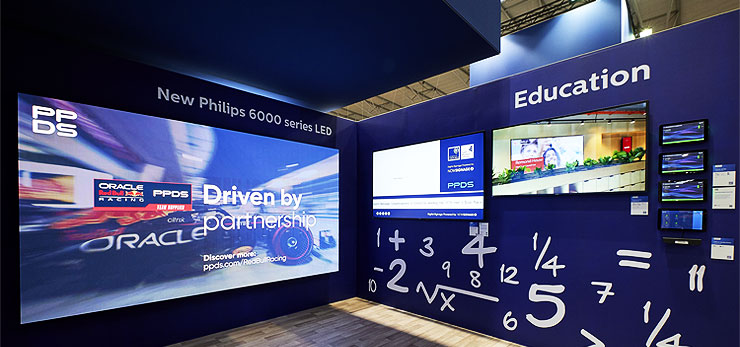
Leverage motion to shape narrative arcs that guide attention, evoke emotion, and prompt immediate responses: sequenced movement—entrance, emphasis, exit—establishes context, highlights key benefits, and closes with a decisive call-to-action. The approach uses cinematic pacing and rhythmic shifts to craft short, memorable scenes that respect viewer autonomy and encourage exploration. Motion should clarify, not distract; each gesture must serve a single idea, liberating recall and motivating voluntary engagement. Strategic timing lets audiences absorb meaning without feeling coerced, reinforcing brand identity as enabling rather than prescriptive.
- Slow reveal of product in open space, suggesting possibility.
- Rapid close-ups on benefits, implying confident competence.
- Flowing background motion that breathes, signaling freedom.
- Clean exit sweep that leaves a visual invitation to act.
Call-To-Action Sequencing
Motion-driven sequences set the stage; Call-To-Action sequencing converts that momentum into measurable responses by arranging prompts to match pacing, emotion, and memory windows. It prioritizes clear micro-actions—scan, save, visit, subscribe—timed to visual peaks so audiences retain and act without feeling constrained. Strategic CTA sequencing aligns with Funnel mapping: awareness cues lead to engagement prompts, mid-funnel social proof invites consideration, and low-friction exit prompts capture conversion. Content blocks are brief, autonomous, and repeatable to respect viewers’ freedom while guiding decisions. Metrics tie creative beats to outcomes, enabling rapid iteration: A/B test placements, timing, and wording to reduce friction and amplify lift. The result is a permissive yet purposeful system that converts attention into measurable brand growth.
Technical Best Practices for Reliable, Safe Installations
Consistently, a successful LED video wall installation begins with rigorous planning that aligns site conditions, structural assessments, and electrical capacity with the chosen display specifications; this upfront rigor minimizes downtime, reduces risk, and protects brand integrity. The technical approach emphasizes predictable reliability and safe operation while enabling operators freedom to adapt content and space.
- Conduct structural and environmental surveys to place mounts, access paths, and service clearance for long-term maintenance.
- Specify cable management routes and labeling to prevent signal loss, simplify swaps, and keep aesthetics clean.
- Design power redundancy with UPS and segmented circuits to maintain uptime during failures and planned work.
- Implement monitoring, thermal controls, and certified installers to guarantee compliance, safety, and predictable performance over time.
Measuring Performance: Metrics That Prove ROI
After establishing the structural, electrical, and operational foundations that guarantee reliable, safe LED video wall performance, attention shifts to quantifying impact so investments can be justified and optimized. Decision-makers prioritize measurable outcomes: dwell time, conversion lift, foot traffic shifts, and ad recall rates. Engagement analytics captures on-screen interactions, view duration, and demographic trends, feeding dashboards that clarify audience behavior. Attribution modeling links display impressions to downstream sales and digital actions, isolating the video wall’s contribution within multi-channel campaigns. Cost-per-engaged-view and incremental revenue per display provide direct ROI lenses. Strategic testing—A/B creative, time-slot variation, and location comparisons—refines content and scheduling. Clear, consistent metrics empower brands to scale installations where freedom to experiment yields demonstrable return.
Avoiding Common Design and Operational Pitfalls
In avoiding common design and operational pitfalls, planners must prioritize clarity of objectives and alignment across stakeholders to prevent costly rework and underperformance. The team assesses site sightlines, environmental exposure, and content strategy before procurement. Contracts specify maintenance scheduling and service-level targets; technical specifications mandate power redundancy and modular access. Design decisions favor scalability and simple failover to preserve brand voice without operational friction.
- A rooftop installation with defined sightlines and service corridors to enable quick panel swaps.
- An indoor atrium where ambient light studies inform pixel pitch and content contrast.
- A retail facade designed with redundant power feeds and distributed controllers for uptime.
- A stadium deployment embedding maintenance scheduling into event calendars to avoid disruptions.
Frequently Asked Questions
How Do LED Video Walls Affect Building Energy Consumption?
LED video walls increase building energy consumption through added power draw and consequential heat generation; strategic deployment and efficient controls mitigate impact, enabling occupants greater operational freedom while preserving comfort and lowering peak demand with smart scheduling and cooling integration.
What Are Typical Maintenance Costs Over a Video Wall’s Lifetime?
Typical lifetime maintenance runs 2–6% of initial cost annually; annual servicing plus occasional module replacements may total $5,000–$30,000 per year depending on size, brightness and usage, offering predictable operational freedom.
Can LED Walls Integrate With Third-Party Social Media Feeds?
Yes. The system readily integrates social media via live aggregation, enabling hashtag displays and moderated streams; stakeholders gain strategic control, flexible freedom to shape real-time content, and persuasive, brand-aligned experiences across platforms.
Are There Financing or Leasing Options for Large-Scale Video Walls?
Yes. Organizations can access financing partnerships and operating leases to acquire large-scale video walls, enabling cashflow flexibility and upgrade options. Strategic agreements preserve operational freedom while aligning payment terms with campaign cycles and ROI expectations.
What Permits or Zoning Approvals Are Usually Required?
Typically, municipalities require building permits, electrical permits, sign permits and sometimes conditional use approvals; permit timelines and zoning variances vary by jurisdiction. A strategic applicant pursues expedited reviews to preserve site freedom and operational flexibility.
Conclusion
LED video walls, when deployed with strategic scale, placement, and pixel-accurate resolution, become measurable brand engines. Effective content prioritizes clarity, motion hierarchy, and calls to action to maximize recall and conversion. Rigorous technical standards and proactive maintenance guarantee uptime and safety, while defined KPIs—engagement, dwell, conversion, and CPM—demonstrate ROI. By avoiding common design and operational pitfalls, brands transform large-format displays from costly novelties into reliable, performance-driven assets that consistently amplify messaging and business outcomes.